
Written by: Marián Šeliga
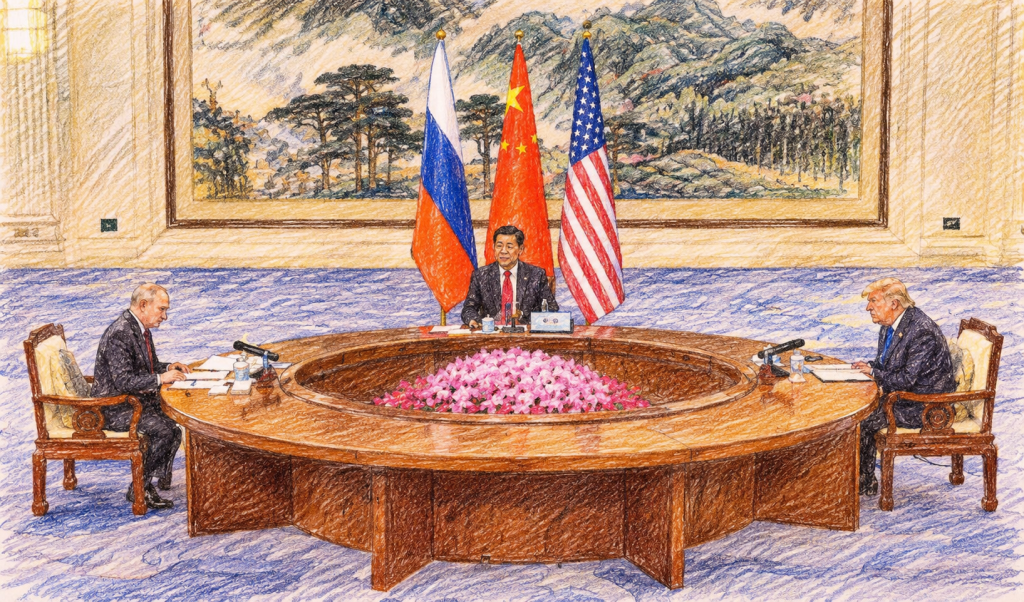
The trilateral meeting in Shenzhen unfortunately produced no major geopolitical breakthrough. Yet its diplomatic choreography, official language and political symbolism suggest that Russia may have gained from the encounter.
The trilateral summit between Chinese President Xi Jinping, Russian President Vladimir Putin and US President Donald Trump, held on 19 November 2026 in Shenzhen, China, attracted considerable international attention. Much of the commentary focused not so much on the substance of the meeting as on the diplomatic choreography surrounding it, particularly the reception of the three leaders and their treatment during official ceremonies.
Some Western and Ukrainian commentators interpreted these details as signs of a shifting hierarchy among the three powers, arguing that China had deliberately sought to put Putin in a subordinate position, or even to humiliate him. They pointed, in particular, to the fact that Putin was welcomed at the airport by Cai Qi, a senior Chinese Communist Party official, rather than by Xi Jinping himself. Further attention was drawn to the positioning of the leaders during the official photo opportunities, where Putin was not standing alongside Xi but next to his wife, as well as to the choice of music played as he entered the reception venue: Tchaikovsky’s The Nutcracker rather than the Russian national anthem, which was reportedly played for Trump.
Diplomatic protocol is a language of gestures, conventions and carefully calibrated signals, and even seemingly minor details can carry political meaning. And the commentators making fun of Putin are right in this respect. At the same time, not every difference in ceremonial treatment necessarily reflects a deliberate political message. More importantly, an excessive focus on these symbolic gestures risks oversimplifying the complex dynamics of international relations and distracting from the bigger picture: what the summit actually means for Russia, its relationship with China and its position in the broader geopolitical landscape.
Diplomatic Protocol and the Question of Humiliation
One of the most widely discussed aspects of the summit was Xi Jinping’s decision to personally welcome Donald Trump upon his arrival in China, while Vladimir Putin was received as commentators put it “only” by Cai Qi, a senior member of the Chinese Communist Party’s Politburo Standing Committee and one of Xi’s closest associates. This difference in protocol quickly became a major talking point in both official and unofficial media coverage. Numerous commentators portrayed it as evidence that Beijing was deliberately seeking to “show Putin his place” or even humiliate the Russian president.
However, a closer look at diplomatic practice and previous high-level visits suggests that such conclusions may be premature. For instance, during a state visit to Russia in 2023, Xi was welcomed by a Russian deputy prime minister Dmitrij Chernyshenko, and during a state visit to Russia in 2025 he was welcomed by Deputy Prime Minister Tatyana Golikova. This did not prevent the two presidents from maintaining close political relations and holding high-level meetings during those visits.
There is another interesting comparison that has received considerably less attention. When Japanese Prime Minister Sanae Takaichi arrived in Shenzhen for the summit, she was received by Zhang Qiyue, a retired Chinese diplomat and former ambassador to Greece, rather than by a senior serving political official. Her father, incidentally, had served as China’s ambassador to Japan. Her reception was considerably more subdued than that of several other visiting leaders. Yet this episode was largely understood in the context of the strained relations between Beijing and Tokyo, rather than being treated as evidence of some broader diplomatic realignment.
The point is not that diplomatic protocol carries no political significance. Quite the opposite: it is an important instrument of diplomatic signalling. China has, in fact, been careful to maintain the appearance of respect for Putin and the strategic relationship with Moscow throughout the summit.
It is therefore disappointing to see how readily some media outlets and even politicians have jumped to conclusions, often without placing individual gestures in their proper diplomatic and historical context. A trilateral meeting involving three major powers deserves a more professional and nuanced assessment than a running commentary on who welcomed whom at the airport.
The seating arrangement during the trilateral meeting provides another example of how diplomatic symbolism can be interpreted in different ways. Xi Jinping occupied the central position as the host, with Vladimir Putin seated to his right and Donald Trump to his left. From the perspective of conventional diplomatic protocol, this arrangement does not provide convincing evidence of an attempt to humiliate the Russian president.
Indeed, if one were determined to attach hierarchical significance to the seating order, Putin’s position to the right of the Chinese leader could just as easily be interpreted as a position of particular distinction. The more reasonable conclusion is that the arrangement, taken in isolation, tells us relatively little about the underlying balance of power.
While some ceremonial moments may have appeared more favorable to Trump, there is insufficient evidence to conclude that the purpose of the diplomatic protocol was to publicly diminish Putin or demonstrate Russia’s subordinate position.
A Summit Without a Major Breakthrough
Beyond questions of protocol, the more important issue for analysts are the results which the summit has come with. Despite the unprecedented nature of the reported meeting, it did not appear to produce a fundamental transformation of international relations. Nor did it deliver a comprehensive agreement on the war in Ukraine or establish a new international security architecture.
The reported joint declaration addressed several important areas, including United Nations reform, energy security, respect for the immunities of state officials and the reduction of nuclear risks. These commitments should not be dismissed. In particular, dialogue among the three major nuclear powers on strategic stability would be significant at a time of considerable international tension.
Nevertheless, general declarations are not equivalent to binding policy changes, and practical consequences depend on whether governments translate commitments into concrete measures. In this sense, the summit’s symbolic dimension may be more important than any immediate policy
breakthrough.
Russia’s Diplomatic Gains
The central hypothesis of this analysis is that Russia emerged as the summit’s central beneficiary. For Moscow, the summit in Shenzhen may have delivered several important advantages even without producing substantial agreements on the issues most directly affecting Russian interests. The first concerns international recognition.
Since the beginning of Russia’s full-scale invasion of Ukraine in 2022, Western governments have pursued policies designed to impose diplomatic and economic costs on Moscow. These measures have included sanctions, restrictions on political engagement and efforts to limit Russia’s participation in certain international forums.
However, Russia has never been universally isolated. It has maintained substantial relationships with China, India and numerous countries across Asia, Africa, the Middle East and Latin America. The summit’s imagery reinforced this reality. By participating in a trilateral meeting alongside the presidents of China and the United States, two superpowers, Putin appeared as one of three leaders engaged in discussions about international security and strategic stability.
This does not imply that the other participants endorsed Russia’s military actions in Ukraine. Nor does diplomatic engagement confer legal legitimacy on those actions. It does, however, demonstrate that Russia remains a participant in high-level international diplomacy and cannot simply be excluded from every discussion concerning global security. For Moscow, the political value of this image should not be underestimated.
The International Criminal Court and Political Legitimacy
A particularly important element of the reported joint declaration concerns the International Criminal Court. The leaders reportedly emphasized the importance of state consent and respect for the immunities of state officials, while warning against abuses of jurisdiction. This language is especially relevant to Russia because the ICC issued an arrest warrant for
Vladimir Putin in March 2023 in connection with alleged war crimes involving the unlawful deportation and transfer of Ukrainian children.
Such a declaration would not invalidate that warrant, nor establish that serving heads of state are automatically beyond the Court’s jurisdiction.
Nevertheless, the inclusion of language concerning state consent, official immunities and judicial jurisdiction could be politically useful to Moscow. Its significance lies less in any immediate legal consequence than in the diplomatic context in which the statement was adopted. A declaration
jointly issued by China, Russia and the United States carries a different political weight from a statement made by Moscow alone.
A New Mechanism of Great-Power Diplomacy?
A second potential advantage for Russia concerns the format of the meeting itself. It brought together the leaders of three permanent members of the United Nations Security Council and three major nuclear powers in a single diplomatic setting. Although the meeting did not establish a permanent trilateral institution, it could provide a precedent for direct dialogue among Washington, Beijing and Moscow on global affairs. From Russia’s perspective, such a format is attractive because it places Moscow at the same negotiating table as the United States and China.
This is not necessarily evidence of equal economic or political influence. China’s economic weight and the global reach of American power differ considerably from Russia’s position. Nevertheless, diplomatic formats possess their own political significance. Being recognized as a participant in discussions on strategic stability can strengthen Russia’s claim to continued great-power status. Whether this trilateral format develops into a durable
mechanism remains uncertain and would require sustained political commitment from all three governments.
The Shadow of Yalta
The meeting also invites comparison with one of the defining moments of twentieth-century diplomacy: the Yalta Conference of February 1945. At Yalta, the leaders of the Soviet Union, the United States and the United Kingdom discussed political and security arrangements that would
shape the postwar international order. The analogy is imperfect. The international system of 2026 differs fundamentally from that of
1945, and this summit did not produce an agreement dividing the world into spheres of influence.
Moscow has long argued that international security should be based on recognition of the interests of major powers and that Russia must participate in decisions affecting the European and global security order. It is therefore plausible to interpret Russia’s interest in trilateral dialogue as part of a broader effort to secure recognition of its status as one of the principal actors in international affairs.
In this interpretation, Moscow may have hoped that the meeting would become a symbolic step toward a new form of great-power diplomacy, perhaps even a contemporary equivalent of Yalta. Such an ambition, however, should not be confused with an achieved outcome. The summit did not establish a new global settlement, resolve the conflict in Ukraine or produce an agreement on competing spheres of influence. Nor is there sufficient evidence here to conclude that Russia alone initiated the meeting specifically to pursue a Yalta-style arrangement.
Beijing has presented the trilateral meeting as a major success, officially describing it as “a landmark event that will go down in history” and a “peace summit”. At the same time, Chinese state media have strongly rejected comparisons with “Yalta 2.0”.
Wu Xinbo, Dean of the Institute of International Studies at Fudan University, dismissed comparisons between the summit and the historical Yalta Conference, arguing that the leaders would neither negotiate or settle major issues nor seek to carve out spheres of influence.
Symbolism May Matter More Than Immediate Results
The summit illustrates an important distinction between diplomatic achievements and substantive policy outcomes. Measured exclusively by concrete agreements, the meeting appears to have produced relatively limited results. Measured by political symbolism, however, its significance
may be considerably greater.
For China, it demonstrated Beijing’s ability to convene the leaders of the United States and Russia and position itself at the center of an important diplomatic initiative. For the United States, it provided an opportunity to engage both strategic competitors in discussions concerning nuclear
risks and international stability. For Russia, the benefits were different but potentially substantial.
The summit offered Moscow high-level international visibility, reinforced its continued participation in great-power diplomacy and reportedly produced language concerning judicial jurisdiction that may serve Russian diplomatic arguments. These outcomes do not reverse Russia’s international difficulties or eliminate the political, economic and legal consequences of the war in Ukraine. They do, however, complicate narratives that portray Russia as entirely excluded from international diplomacy.
The meeting did not produce a new Yalta. It did not resolve the war in Ukraine, and it did not fundamentally reshape the international order. Yet for Russia, the very fact that the meeting took place may have been an important achievement. That is why the summit deserves to be analyzed
not only through the images of diplomatic protocol, but also through the language of official documents, the interests of its participants and the broader strategic context.

