
By Marián Šeliga, Head of China desk, Advisor to the Board at J&T Banka
Xi opens SCO summit in Tianjin with speech calling for reforming current global governance system
India’s Prime Minister takes part in the summit and shakes hands with Xi Jinping
The summit, along with the information released on its sidelines, signals that Trump’s policies have destabilized the world and may have drawn China, India, and Russia closer together
Russia and China sign a memorandum to advance construction of the long-delayed ”Power of Siberia 2” pipeline and increse the output of ”Power of Siberia 1”
I carefully listened to the official speech delivered by Chinese President Xi Jinping at the opening of the Shanghai Cooperation Organisation (SCO) summit in Tianjin on August 31, 2025, and sought to highlight some of the key ideas he put forward. In addition, I have covered the major events that took place over the four-day period of gatherings in China, which primarily brought together countries of the ‘Global South.’ These events included the 25th SCO summit in Tianjin (August 31–September 1), a series of bilateral meetings, and a military parade commemorating the defeat of Japan in World War II.
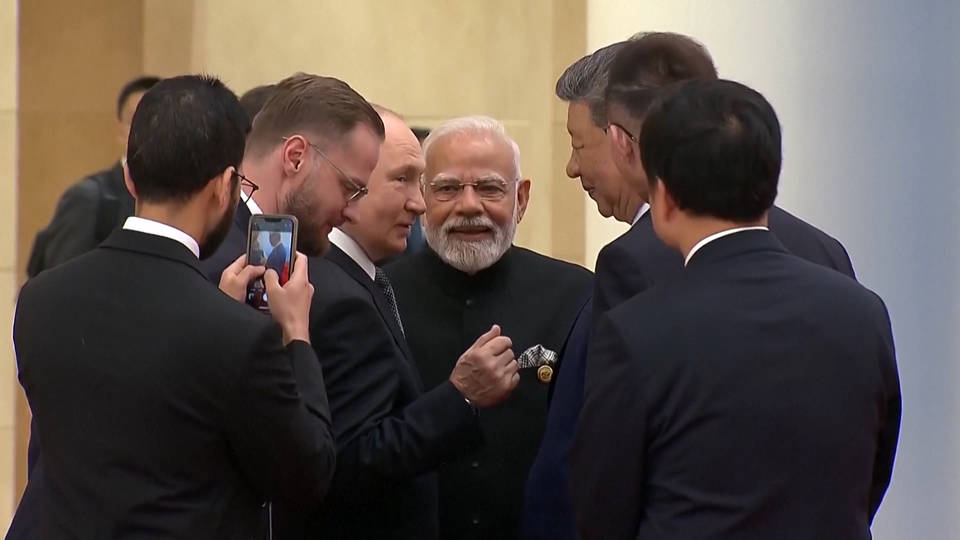
The 25th SCO summit convened more than 20 leaders, including Russian President Vladimir Putin, Indian Prime Minister Narendra Modi, and Chinese President Xi Jinping. The organization consists of ten full member states: Russia, China, India, Iran, Kazakhstan, Kyrgyzstan, Pakistan, Tajikistan, Uzbekistan, and Belarus. Mongolia and Afghanistan hold observer status, while other participants are designated as dialogue partners.
In his opening word at the SCO summit Chinese President Xi Jinping emphasized that ”the Shanghai Cooperation Organization has grown into the world’s largest regional organization, with 26 participating countries, cooperation in more than 50 fields, and a combined economic output approaching 30 trillion US dollars. Its international influence and appeal continue to rise.”
A major issue that has sparked wide discussion was Xi Jinping’s call for fairer treatment of all countries, particularly developing countries, in the global system. Staying true to China’s longstanding commitment to peaceful coexistence, Xi introduced the Global Governance Initiative (GGI) — a proposal for a more just and equitable international order, in which all countries are treated on an equal footing.
According to Xi, this new initiative will be based on five principles: 1) respecting the sovereign equality of all countries, with greater representation for developing nations in the system of international relations; 2) adhering to international rule of law; 3) upholding multilateralism and opposing unilateralism; 4) promoting a people-centered approach; and 5) focusing on real actions.
Although China is striving for greater leverage and influence in the system of global governance, similar calls were already vocal before the Tianjin meeting and reflect the broader ambitions of rising powers and large developing countries to gain stronger representation in global decision-making.
While European leaders, including EU foreign policy chief Kaja Kallas, criticize the gathering in Beijing as a meeting of autocrats threatening the post–Second World War international order, their statements remain largely rhetorical, with no concrete action from the EU—perhaps because the Union has little real leverage. It’s also worth noting that US–EU relations today are far from ideal, with the current US administration taking a more assertive stance in defending its own interests, even when allies are at the negotiation table. When it comes to engaging with two major Asian powers—India and China—the EU’s voice tends to be mainly critical, yet its presence in the Indo-Pacific, where the geopolitical agenda is increasingly being shaped, remains very limited.
Meanwhile, rising powers—chiefly China—closely observe both the shortcomings of Donald Trump’s trade policy, which tends to “disconnect rather than connect,” and the European Union’s preoccupation with the war in Ukraine. Together, these factors create greater opportunities for China to advance its agenda and promote its vision of a multipolar, rather than unipolar, world order. The unresolved question is how these ambitions can be translated into practice.
Global agenda: The war in Ukraine. Sino-India thaw in relations.
Although numerous bilateral meetings took place during the SCO summit and several statements were made, no new signs of progress emerged regarding a potential standoff or resolution of the war in Ukraine. What is more, on the sidelines of the summit, Russian Presidential Advisor Yuri Ushakov told journalist Pavel Zarubin that there was no agreement between U.S. President Donald Trump and Russian President Vladimir Putin to meet with President Volodymyr Zelensky. This statement contradicts with Trump’s earlier claims and signals that Trump’s latest summit in Alaska — and his promise to put an end on the war in Ukraine — is highly possibly proving to be a complete failure.
At the same time, Trump’s weak stance toward Russia—as well as toward other countries that continue purchasing Russian oil (with the notable exception of India)—has given both China and Russia considerable leverage. The two powers also held a symbolic handshake meeting with Indian Prime Minister Modi, which has sparked discussion in Western media. Although Indo-Chinese relations have long been complicated at the highest political level, the recent meeting between Modi and Xi was relatively courteous. Modi’s personal attendance at the SCO summit may indicate that India is exploring a new diplomatic approach to improve ties with China. At the same time, it could also serve as a signal to Washington that India should not be humiliated by measures such as the 50% tariffs on Indian goods, imposed largely because it continues to purchase Russian oil.
At the same time, signs of rapprochement or cautious engagement between China and India have been observed before the summit in Tianjin. Xi met with Modi in person on the sidelines of the BRICS summit in Kazan last year and both countries have taken measures to reduce tensions on disputed borderline.
Nevertheless, the lingering standoff in eastern Ladakh (on the India–China border), China’s support and close ties with Pakistan, and Beijing’s plan to build the world’s largest dam with potential consequences for India remain serious points of tension in the bilateral relationship. On the one hand, these issues could be managed if the need arises; on the other, they could quickly escalate into crisis. For this reason, it is premature to conclude that a new anti-U.S. axis of powers—India, Russia, and China—is firmly taking shape.
India maintains close ties with Russia and effectively disregards Western sanctions and Moscow’s isolation by the West. An analysis from Carnegie Endownment of the SCO summit results reveals a striking fact: while the European Union frequently criticizes India for purchasing Russian oil, the EU itself—directly or through intermediaries—imports even more Russian oil than India.
Subscribe and receive regular in-depth analysis on top international issues absolutely for free. Please support our work by subscribing to our website.
Although history has shown that an unexpected thaw in bilateral relations can break down at any time, Trump’s short-sighted and erratic policies have not only strengthened ties between China and Russia, but also encouraged India to pursue greater strategic autonomy in its foreign policy. Moreover, Indian citizens—particularly voters of the ruling Bharatiya Janata Party (BJP), whose pride has been touched by U.S. sanctions—are likely to support PM’s policy to behave more strategically independent. Trump’s slapping of tariffs on India might also breathe new life into the BRICS economic bloc, which some time ago seemed to be a “paper tiger”.
The ”revival” of Power of Siberia 2 project
In terms of concrete bilateral achievements, a number of memorandums were signed among the stakeholders. One that received particular media attention was the memorandum between Gazprom and China’s CNPC on the construction of the Power of Siberia 2 and the Soyuz Vostok transit gas pipeline through Mongolia. According to A. Miller, head of Gazprom, Power of Siberia 2 envisages the supply of 50 billion cubic meters of gas per year from Russia in transit to Mongolia.
Gazprom also agreed to increase annual shipments through the existing Power of Siberia line, which runs from eastern Siberia, from 38 billion cubic meters to 44 billion.
Although Russian media describe this memorandum as ”legally binding”, the price of future gas supplies, details on the financing of the project, and timelines have not been announced. At the same time, A. Miller said that ”the price of gas for China is objectively lower than for Europe due to the shorter transport distance.”
The Power of Siberia project, planned to run through the Altai region and Mongolia, has been under discussion for many years. Back in 2011, the main obstacle to progress lay in disagreements over pricing. At that stage, however, the external environment remained relatively stable, allowing Russia to maintain a stronger negotiating position. Since then, circumstances have shifted significantly. The external conditions have changed in ways that now place China in a much stronger negotiation position, enabling it to exert considerable leverage—particularly with respect to the price at which it is prepared to import Russian gas.
According to Bloomberg, the new pipeline and the expansion of existing capacity could cut China’s demand for liquefied natural gas (LNG) by 40 million tons annually—about half of its LNG imports last year. Chinese rating agency CSCI Pengyuan assigned its highest AAA rating to Gazprom (previously traded on London Stock Exchange, but now blacklisted) paving the way for any debt issuance in China’s domestic bond market.
Military Parade on Tiananmen square
The four-day series of gatherings and bilateral meetings in China concluded with a large-scale military parade. Prime Minister Modi was absent at the parade, but North Korean leader Kim Jong Un marched alongside Xi Jinping and Vladimir Putin in the front row of leaders as they approached Tiananmen Square, where the parade was held. Among the representatives—drawn largely from Global South countries—were also one EU leader, the Slovak Prime Minister, as well as the Serbian President and former high-level officials from Romania. The presence of the latter has raised questions in their home countries.
 Global News Insider