
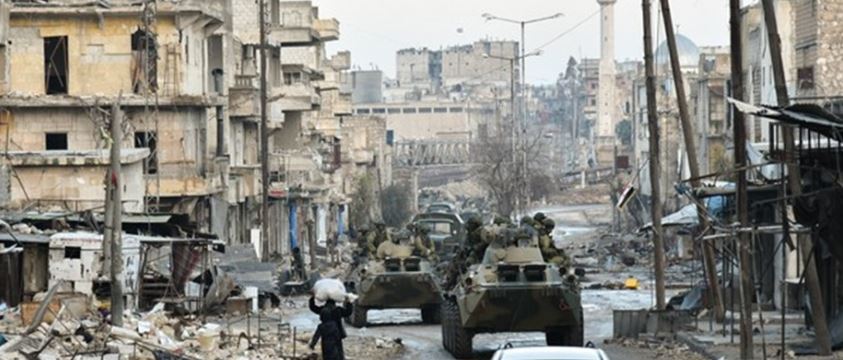
Background information: Civil war in Syria has been raging for 9 years now, but in comparison with other authoritarian regimes in the region, Bashar Assad seems to be the only of the regional rulers who has maintained top office in his country. Regimes in Libya, Tunis, Egypt, Yemen fell, but Assad’s regime continues to fight fiercely against its oposition. What is more, Assad’s army with the support of Russia is consistently pushing the remnants of Syrian opposition troops as well as the Islamic state terrorists out of Syria. Now time has come also for the last beheld of Islamic troops in the province of Idlib. The latter is the last breaking point, where the interests of Syria and Turkey meet.
Turkey is a member state of NATO and for many years has aspired to become a member state of the European Union. President of Turkey R. T. Erdogan is known as an autocratic nationalist leader and his autocracic rule was partly revealed in the suppression of the antipresident coup in 2016 and the following tough measures taken against opposition and journalists. It is reported that Erdogan was warned about the upcoming coup by its eastern partner in the very last moment and that helped him to neutralize the opposition and survive. Now he is not only suppressing the opposition in Turkey, he is again sending its troops to Syria.
Turkey’s ambitions in Syria will result in the new wave of migration crisis in the European Union
Although it is more than clear that Turkey will not become a member state of EU in the foreseable future, Ankara has played a quite specific role in limiting the migration crisis in Europe. In 2016 the Brussels stroke a deal with Ankara under which Turkey in return for financial compensation from the Brussels promised to stop the flood of migrants to Europe. But the latest events in the Syrian province of Idlib clearly showed that Erdogan is not the partner who could be relied upon in this issue and the deal with EU on migrants is not working anymore.
The war in Syria is a very complicated issue which requires a very detailed analysis as well as the analysis of the interests of regional or global powers in Syria. This is not the aim of this short analysis. At the same time we would like to point out that Syria as any other state in the world according to the international law still enjoys the right of territorial sovereignty and the question of Turkey’s troops engagement in clashes on the sovereign territory of Syria is neglected by the international community. The presence of foreign powers’ troops on the territory of Syria (including Turkey and previously USA) is disputable, but it seems that in case of Turkey the international community is incapable to take any action. The European Union until last week was in a position that while it evidently did not appreciated Turkey’s military operation in Idlib, it couldn’t do practically anything, as it still needed Ankara to stop the migration flood to Europe. This approach (closing borders in return for money from the Brussels) is ineffective and requires reconsideration.
The escalation of conflict in the province of Idlib by Turkey creates security risks for the neighbouring countries. Erdogan is right when he says that Turkey is the first station for migrants coming from Syria and the number of these migrants has reached a critical point (about 4 million migrants from Afghanistan, Syria, Iraq, Iran are already in Turkey). On the other hand, it was him who supported the Arab spring movement in 2011 and anti-Assad movement in Syria, while promoting Turkey’s interests in the region. To be fair, there are also other powers trying to leverage their interests in the region. But Turkey supported the movement which resulted in the the civil war in Syria and actively takes part in military operations on the territory of Syria. The war in Syria has already displaced millions of people to other countries including Turkey. Erdogan also came with an idea to establish special zone for migrants in the northern-eastern part of Syria (Rojava), even if that meant that this region (do not forget it is a territory of Kurds within Syria) would be occupied by Turkish army. The response of the EU which is again being affected by new migrant wave is far from effective, if there is any response at all. EU is delivering a message that it has no strategy to cope with the actual situation.
Operation Spring Shield to be launched after the death toll of Turkish soldiers reaches 34
Idlib clashes and Turkey’s active engagement in the region happen against the backgroud of the full impotence of the EU and NATO in exorting their influence on Ankara. Turkey as a regional power puts its own interests on the first place even if that means the higner security risks for its closest neighbours and partners to NATO. Greece which is the first destination for new wave of migrants had historically bad relations with Turkey (e.g. Cyprus issue) although they both are the member states of NATO. But even the partnership in one military bloc doesn’t prevent Erdogan from pushing forward his expansion policy while creating problems to its partners. Turkey has launched new operation in Idlib called Spring Shield, but now stakes are higher, as Assad is supported by the Russian military. Erdogan would definitely not rage an open war with Russia (which supports Assad regime) and there is a need to renegotiate and update Sochi memorandum signed in October, 2019. A new meeting between Russian President V. Putin and Turkish President R. T. Erdogan will be held on March 5. Analysts, carefully monitoring Russian-Turkish relations, remember that just two months ago (in Janurary 2020) Russia and Turkey opened Turkishstream (a new gas route from Russia to Turkey) and Erdogan in his speech talked about very good atmosphere in bilateral relations between two countries. But this atmosphere changed instantly as now there are at stake geopolitical interests of both countries in Syria.
Apart from geopolitical confrontation in Syria we should not forget about the innocent people escaping from their home country. They are not welcomed in Turkey, we would even say they are misused by some groups in the country in their political ambitions. But the member states of the EU are not unite on helping these migrants, even if there is a risk of humanitarian catastrophe. These people were made migrants by political ambitions of regional and global powers. EU has played a minor role in Syria and prefered to pay Ankara to stop migrants at its borders. But this policy of putting the responsibility on others for financial help worked until February 2020 and today more politically responsible and human approach is needed. As many member states of the EU are against opening their borders to migrants (especially in Eastern Europe), the EU must push on Ankara to immediately stop military action in Syria (the main reason for migration), otherwise it could face big problems with migrants.
 Global News Insider
Leave a comment