
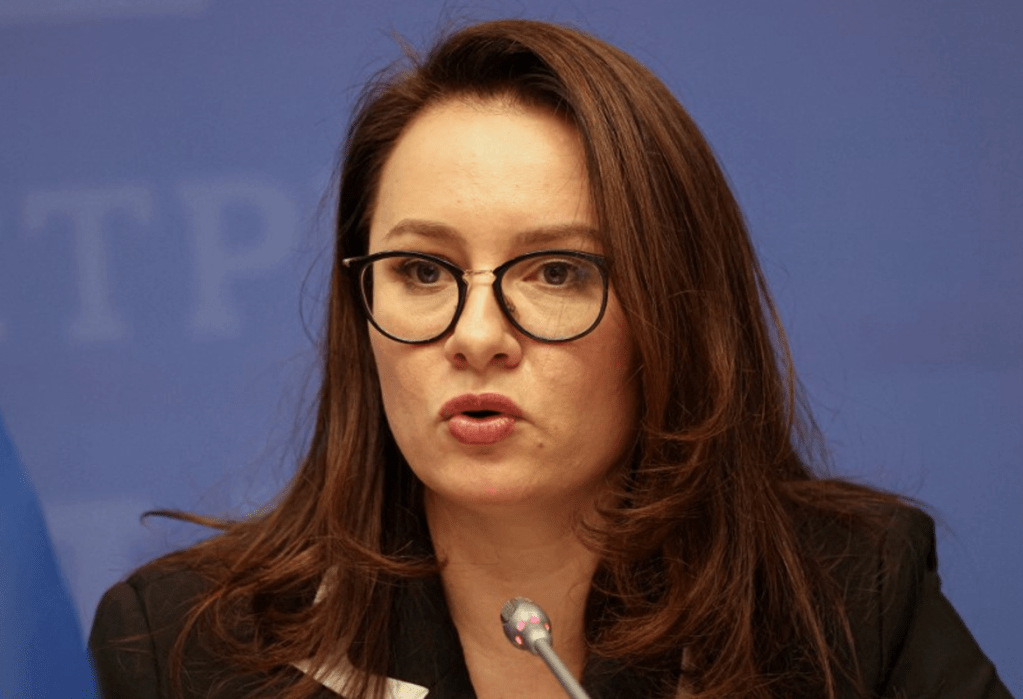
The change in government comes as protesters decry Kyiv’s move against anti-corruption reforms
By: Marián Šeliga, Head of China desk, J&T Bank
Education:
Yulia Svyrydenko was born on December 25, 1985, in Chernihiv. Her father headed the regional branch of Ukraine’s Antimonopoly Committee, while her mother worked in the regional administration. She has a brother, Vitalii, who leads Chernihiv’s regional shooting federation.
In 2003, Svyrydenko graduated from Chernihiv Secondary School No. 1 with a focus on foreign languages and enrolled at Kyiv National University of Trade and Economics. She earned a master’s degree in 2008 in “Antimonopoly Management” and later pursued postgraduate studies in national economic management.
In 2009 and 2011, she completed property and business valuation courses at Ukraine’s State Property Fund.
In 2016, Yulia Svyrydenko completed a management training program at the German Management Academy of Lower Saxony and in 2017 a private sector growth strategy course with Sweden’s Sida.
Since 2023, she has been a guest lecturer at the Kyiv School of Economics (KSE). In 2025, Ukraine’s National Agency for Corruption Prevention launched a probe into her compliance with anti-corruption laws after MP Volodymyr Ariev questioned her KSE salary. Svyrydenko declared ₴3.1 million ($74,000) in teaching income for 2024. KSE President Tymofiy Mylovanov confirmed she earns over $6,000 monthly.
Business career:
In 2008, Svyrydenko worked in finance at AMP, a Ukrainian-Andorran real estate firm, then as a property appraiser in Chernihiv. In 2011, she became head of Chernihiv’s permanent office in Wuxi, China, focusing on attracting investment. She learned Chinese to engage investors, leading to the creation of Eco-Vtor, a Ukrainian-Chinese company that built a polyester fiber plant in Chernihiv, where she served as deputy director. From March to September 2019, Svyrydenko was director of Sidco Ukraine, a company producing wild bird feed and processing organic products.
Political career
In 2015, Yulia Svyrydenko began working in the Chernihiv Regional State Administration. From May to August that year, she served as an adviser to the regional governor before heading the Department of Economic Development. Between 2017 and 2018, she was the first deputy head of the administration.
She was invited to lead the economic department by Governor Valeriy Kulich, who later told Forbes Ukraine (2021) that Svyrydenko stood out from other staff for her skills and English proficiency.
During her tenure (2015–2017), the region attracted over $340 million in foreign direct investment, with total investment reaching $430 million. In 2017, Chernihiv region ranked first in Ukraine for investment growth.
From July to November 2018, Svyrydenko served as acting governor but was dismissed after a disagreement between Kulich and President Petro Poroshenko over the region’s development. Kulich later brought her into his company, Sidco Ukraine.
In 2019, Yulia Svyrydenko returned to public service as Deputy Minister of Economic Development, Trade and Agriculture, invited by then-Economy Minister Tymofiy Mylovanov. He described her to Forbes Ukraine as having “a rare, comprehensive understanding of both business and government.” In this role, she worked to formalize the labor market and reduce under-the-table wages.
After a government reshuffle in March 2020, Svyrydenko served for eight months as First Deputy Minister under Ihor Petrashko, then became Deputy Head of the Presidential Office under Andriy Yermak, focusing on economic issues. President Zelensky also appointed her head of the Council for Small Business Development that year.
In November 2021, she was named Minister of Economy and First Deputy Prime Minister, nominated by the ruling Servant of the People party and approved by 256 MPs. In her parliamentary speech, Svyrydenko called for modernizing Ukraine’s economy and moving beyond “Soviet-era standards and bureaucracy.”
In 2021, she also joined the supervisory board of Naftogaz. In summer 2022, she announced plans to raise Ukraine’s GDP to $500 billion within a decade with international support.
As of June 27, 2025, Svyrydenko serves as Deputy Chair of the Presidential Advisory Council on Business Support.
Sviridenko — Prime Minister of Ukraine
On July 13, 2025, sources reported that President Zelensky plans to appoint Yulia Sviridenko as Ukraine’s prime minister. The current defense minister, Rustem Umerov, may replace the ambassador to the U.S., and Prime Minister Denys Shmyhal might take Umerov’s position. Sviridenko previously said she hadn’t received any official offer.
She has openly had ambitions to lead the government but faced challenges, including tense relations with some officials. On July 14, Zelensky officially proposed her for the role and expects a government action plan soon.
Sviridenko thanked Zelensky and said her priorities include boosting Ukraine’s economy, expanding support programs, and increasing domestic weapons production. She emphasized cutting bureaucracy and unnecessary spending to achieve these goals.
On July 17, the Verkhovna Rada approved Yulia Svyrydenko as Ukraine’s prime minister. She took office at 39, though she is not the youngest prime minister in Ukraine’s history—Aleksei Honcharuk (35) and Volodymyr Groysman (38) were younger at their appointments.
Relations with Russia and USA
In 2020–2021, Svyrydenko was part of Ukraine’s Contact Group to resolve the Donbas conflict, representing the social and economic subgroup. In 2022, she led the interagency working group on implementing Ukraine’s sanctions policy.
In spring 2025, she signed a memorandum with the U.S. on Ukrainian mineral resources, stating the agreement would bring significant investment, infrastructure modernization, and a mutually beneficial partnership between Ukraine and the United States.
Analysis
Yulia Svyrydenko’s nomination and rapid rise to prime minister may reflect her successful track record in previous roles, including her work at the Chernihiv Regional State Administration, as Minister of Economy, and in the business sector.
Some analysts believe that the new PM has a close relationship with Head of the Presidential Office Andriy Yermak, suggesting that her appointment is a strategic reshuffle designed to replace the unpopular Denys Shmyhal and refresh the government with a well-qualified and appealing politician.
Additionally, Svyrydenko’s signing of a memorandum with the U.S. on Ukrainian mineral resources indicates that her nomination might have strong backing from American partners.
 Global News Insider