
Photo: FAS.org
Prepared by: Marián Šeliga
Russian Sinologists Forecast What Russia and the World Can Expect from China’s Development by 2049
In the coming years, China is expected to continue rapidly increasing its military spending, advancing its position as the third nuclear superpower. By 2035, Beijing may reach parity with Russia and the United States in terms of strategic nuclear arsenals. This is one of the key findings in the report from the Institute of China and Modern Asia at the Russian Academy of Sciences (ICSA RAS), titled “China-2049: Futurological Analysis,” which was publicly released last week in Moscow. In the report, leading Russian Sinologists analyze major trends in China’s economic and foreign policy development through to 2049—the centenary of the PRC—and explore potential scenarios for China’s role on the global stage, as well as the course Russia might consider most beneficial based on current projections.
Economic Challenges
Given that China has officially been the world’s second-largest economy after the United States for several years, the forecast focuses on what to expect from the country’s economic development in light of various internal and external challenges. Among the internal issues identified by the authors are the weakness of domestic consumption and its slow growth rates. In recent years, individual consumption has accounted for just 40-45% of China’s GDP, compared to around 60% in countries like Brazil or India.
The second major challenge to China’s economic development is its demographics—an aging population, low birth rates, and a shrinking working-age population. Other factors that hinder economic growth include limited natural resources, regional disparities (with the development gap between China’s coastal areas and its central and western regions still present, and a new divide emerging between the southern and northern provinces), and, lastly, China’s lag in fundamental research.
The return to power of Donald Trump, who initiated a trade war with China during his first term, is further evidence that the West’s policy of containing China will continue and likely intensify.
“Despite internal challenges and growing external pressure to contain China, the Chinese economy still possesses a significant margin of safety and potential for continued sustainable development,” the authors conclude.
They summarize by stating that the Chinese economy is likely to reach a new level and transition onto the path of “high-quality development.” It is important to note that, according to the PRC leadership’s plan, by 2049 the country aims to complete its “Chinese-style modernization,” transforming into “a rich, strong, democratic, civilized, and harmonious socialist power.”
Beijing acknowledges that global leadership comes with unpredictable challenges, like pandemics or financial crises, which may require a shift from its current focus on “self-isolation” and internal strengthening. If the external environment supports Chinese activism, Beijing may pursue new forms of international cooperation, addressing issues like climate change and cybersecurity.
Defense policy
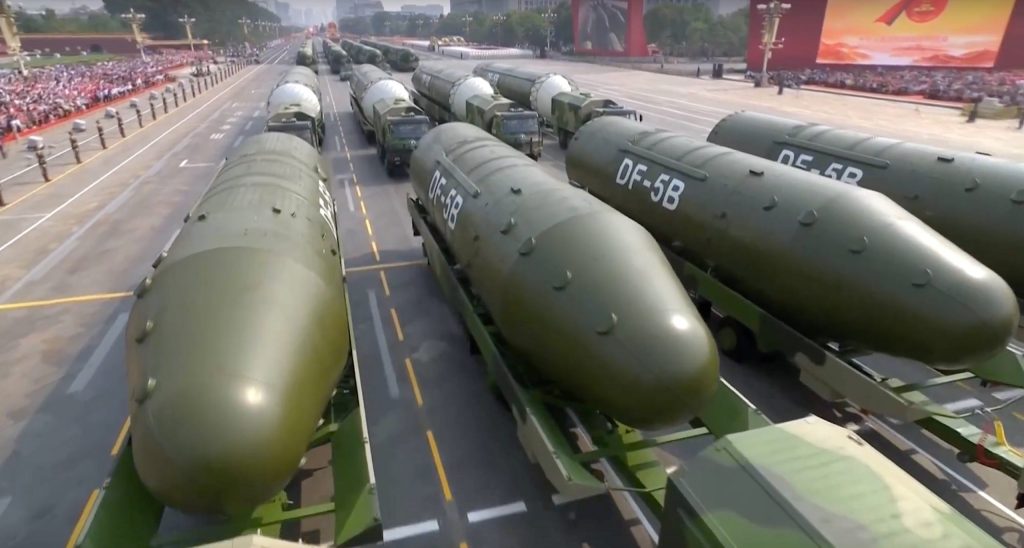
As for China’s defense capabilities, Russian Sinologists conclude that they will continue to grow. Experts predict that in ten years, the PRC, which is currently pursuing a policy of building a “high-level strategic deterrence system,” will officially become the third nuclear superpower.
Beijing is expected to keep expanding its stockpile of intercontinental ballistic missiles, including at least three main types (DF-31, DF-41, DF-5), with increasingly modern modifications.
“The development of this type of weapon signals plans for a significant and rapid increase in China’s nuclear arsenal. As a result, it’s possible that by 2035, China could reach the level of Russian and American strategic nuclear arsenals, as defined by the START-3 treaty, bringing China’s total to around 1,500 nuclear warheads,” the authors suggest.
China’s Naval Expansion and Growing Global Military Presence by 2049
Thanks to the rapid development of its naval fleet, China, currently leading in the pace of commissioning new warships, will gain greater capabilities to assertively support its global interests. By 2049, experts are confident that the Chinese Navy will possess combat potential comparable to that of the US Navy.
At the same time, Chinese authorities will focus on ensuring a permanent military presence in various regions around the world. “While China currently has only one overseas military base in Djibouti, we can expect the establishment of Chinese bases along the west coast of Africa and in the Middle East in the future.” However, the scale of China’s overseas military presence is unlikely to match the current global footprint of the US military.
One of the key conclusions about China’s behavior on the world stage by mid-century is that the country will continue to prioritize economic stability as a central component of its foreign policy, viewing successful economic growth as the foundation of its international influence. At the same time, Beijing envisions itself as the future leader of the Global South, where it will expand its influence by building a network of friendly states, using both economic incentives and a strategy of pressure through sanctions.
As for the “most important relationship in the world” — the one between China and the United States — the authors conclude that the rivalry between Beijing and Washington will persist, but by mid-century, it is unlikely to lead to a complete “divorce” between the two.
The Asia-Pacific region will continue to experience tensions between China and its neighbors, exacerbated by US involvement. Disputes over resources in the South and East China Seas, Taiwan, and tensions with India and others heighten the risk of regional conflicts. China’s preference for using force over negotiation may provoke retaliatory actions from other countries.
China’s Approach to Global Rivalries and Its Relationship with Russia
China is likely to remain flexible in its foreign policy, avoiding direct confrontation and seeking compromises, while still taking advantage of divisions within the Western camp.
In its relations with Moscow, Beijing will maintain “strategic flexibility and foresight,” recognizing Russia’s importance as an ally and valuing security along its northern border. However, China will avoid making overly rigid commitments to Moscow. Specifically, the idea of a formal military alliance between the two countries—often discussed by experts and the media in recent years—will only become a reality in the event of a full-scale war.
The most likely scenario, according to the authors, is the continuation of controlled competition between China and the West. In this context, Russia should focus on strengthening its comprehensive cooperation with Beijing to mitigate threats from the West, while also actively developing ties with other non-Western centers of power.
“A consistent policy of multilateral diplomacy and participation in global initiatives can help avoid isolation and enhance sovereignty amidst ongoing rivalry. Such a course would be optimal for Russia as a whole,” the authors conclude.
The weakening of China amid the strengthening of the West, as well as a noticeable overtaking of the US and its allies by China (with experts considering the first scenario less likely, while the second holds somewhat higher probability), would be detrimental for Russia. “A crisis in China would create significant problems for both the Russian economy and security, and a weakened PRC would result in Russia losing crucial support in its confrontation with a stronger West,” the report predicts in the first scenario.
The success of the second scenario would create both opportunities and challenges for Russia. “It remains unclear how China would behave if it were to become the sole global leader. While PRC leadership has stated it does not seek to establish hegemony in the world system, nationalistic sentiments are already present within the country’s elite, and these may intensify as national pride grows. This could negatively affect China’s relations with its neighbors, including Russia. In such conditions, the current trend of relying unilaterally on Beijing in foreign policy may evolve into a situation of unilateral dependence,” Russian Sinologists caution.
 Global News Insider