
By: Marián Šeliga
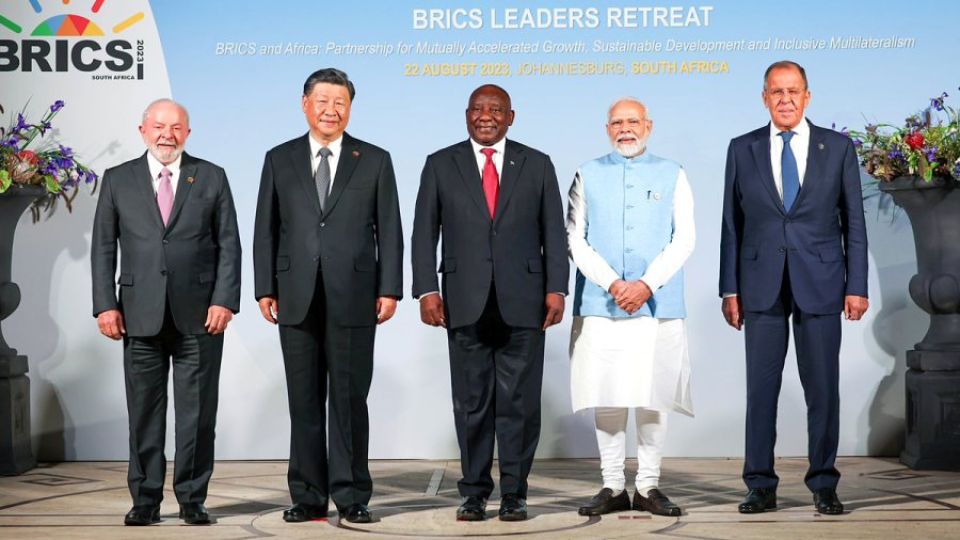
The 15th BRICS summit, which took place from August 22nd to 24th in South Africa, has reaffirmed the growing aspirations of developing and emerging nations to assume a more impactful role on the global stage. Current BRICS summit was first in-person gathering in four years after the COVID-19 pandemic. BRICS member countries seek to reform the existing global governance model to ensure greater fairness for their interests.
According to Johannesburg II declaration signed on 23 August the common goal of BRICS institution and other developing countries is greater representation of emerging markets and developing countries in international organizations and multilateral fora in which they play an important role.
The Russian President V. Putin took part in the summit only virtually and Russia was represented in S. Africa by its Foreign Minister S. Lavrov. While China’s leader, Xi Jinping, engaged in a bilateral meeting with South African President Cyril Ramaphosa on the inaugural day of the summit, he did not participate with other leaders in a business forum held at the main summit venue. The specific reasons for his absence were not specified. Instead, China’s Commerce Minister, Wang Wentao, delivered Xi’s speech during the forum.
The main achievement of the summit was definitely the decision of the heads of BRICS to invite Argentina, Iran, Ethiopia, Egypt, Saudi Arabia and the UAE to become full-fledged participants in the organization. Their membership in BRICS will begin on June 1, 2024. The expansion is only the second in the history of the group, while around 22 countries have formally expressed an interest in joining the bloc. As a result of the enlargement by 6 new fellow members, the organization would be referred to as BRICS6.
One clear observation regarding the expansion of BRICS is the increasing popularity of its concept of enhanced collaboration among Global South nations. This trend resonates particularly among emerging and developing countries, especially those with negative past experiences of colonial rule and those that perceive themselves as marginalized within the global governance framework, which is predominantly controlled by Western nations.
It is important to point out that invitation of new members was the result of tough negotiations between the current members countries, as they have their own agendas and aims while forging cooperation within BRICS. India’s greatest concern about the expansion is that BRICS shouldn’t become a China-centric grouping, especially at a time when relations between India and China are compromised by their border dispute.
The president of Brazil emphasized that BRICS is not opposed to any other organization and it is not against cooperation with the USA. This again supports the idea that member countries have different views on some important issues. Brazil is certainly keen on maintaining its ties with the American market and avoiding any disruption to its trade relations with the United States. Similar sentiments can be extended to India as well.
On the flip side, China’s relationship with the US is under significant strain, steadily worsening. As a result, China is placing its bets on forging stronger collaborations with nations in the Global South. The BRICS format appears to be a strategic move that could yield positive results for China’s endeavors. China is certainly interested in expanding the membership of this organization to include more new members, aiming to amplify the collective voice of emerging nations.
Chinese representative, Commerce Minister Wang Wentao delivering Xi’s speech at the forum emphasized that “some country obsessed with maintaining its hegemony has gone out of its way to cripple the emerging markets and developing countries“.
Significant optimism was pinned on BRICS by external experts, particularly those hailing from developing nations or who hold a critical stance toward the Western world. There was a prevailing hope that BRICS could usher in a revolutionary shift in the global payment market’s financial framework. This hope centered on the potential reduction of the US dollar’s dominance in intergovernmental trade and banking operations within BRICS. However, it appears that, for the time being, this matter remains more of a “buzzword” than a feasible agenda. Actually the topic of a new payment system or common currency was only slightly touched upon during the summit. Notably, at the conclusion of the BRICS summit, the bloc’s leaders announced they would task their respective finance ministers to learn more deeply the the issues of local currencies, payment instruments and platforms and report back in a year.
Presently, within the BRICS framework, two particularly impactful structures are in operation: the New Development Bank (NDB) and the BRICS Business Council. The NDB is notably proactive in channeling financial resources toward critical infrastructure initiatives within emerging and developing nations, although in terms of scope of financing it still lags behind the Asian Infrastructure Investment Bank.
*BRICS – BRICS is a grouping of the world economies of Brazil, Russia, India, China and South Africa formed by the 2010 addition of South Africa to the predecessor BRIC. The initial goal of BRICS was to establish a just, democratic and multipolar world order. It currently makes up a quarter of the global economy, accounting for a 1/5 of global trade, and is home to more than 40% of the world’s population.
 Global News Insider