
Author: Marián Šeliga
On 9 May, Moscow held the traditional Military Parade in commemoration of Victory Day, marking the 78th anniversary of Russia’s triumph over Nazi Germany. It is noteworthy that, in contrast to the previous year when no foreign leaders attended the Parade, the presence of six presidents and one prime minister has sparked significant curiosity and inquiry.
Among the attendees were the leaders of the five Central Asian republics (Kazakhstan, Uzbekistan, Tajikistan, Kyrgyzstan, and Turkmenistan), along with Armenian Prime Minister Nikol Pashinyan and Belarusian President Alexander Lukashenko. This gathering occurred merely three weeks after V. Putin faced charges of military misconduct by the International Court in The Hague.
Subscribe and receive a weekly in-depth analysis on top international issues absolutely for free. Please support our work by subscribing to our website.
The presence of Belarusian President Lukashenko at the Parade was largely anticipated, given the close relations between Russia and Belarus. However, the attendance of Kyrgyz leader Japarov and Armenian Prime Minister Pashinyan caught the attention of foreign experts. It appears that Armenia sees Moscow as a crucial geopolitical player in its increasingly complex negotiation process, which has yielded minimal tangible outcomes following the Washington meeting and provides little optimism for Yerevan after the Brussels meeting. Conversely, Japarov’s participation came as a surprise, particularly considering the visible cooling in Russia-Kyrgyz relations during 2022. Japarov opted not to attend the Russia-led Commonwealth of Independent States (CIS) gathering in St. Petersburg on Putin’s 70th birthday, and even cancelled CSTO training drills with Russia.
Among unexpected visitors of the military parade in Moscow was the new Kazakh president Tokayev who has been considered by foreign experts as a man who would try to dismantle authoritarian regime of his predecessor Nazarbayev by implementing new reforms and fighting rampant corruption in the country. The Kazakh President Tokayev has not backed Moscow’s military campaign in Ukraine and eved declared that Kazakhstan would not assist Russia in circumventing sanctions.
EAEU summit in Moscow
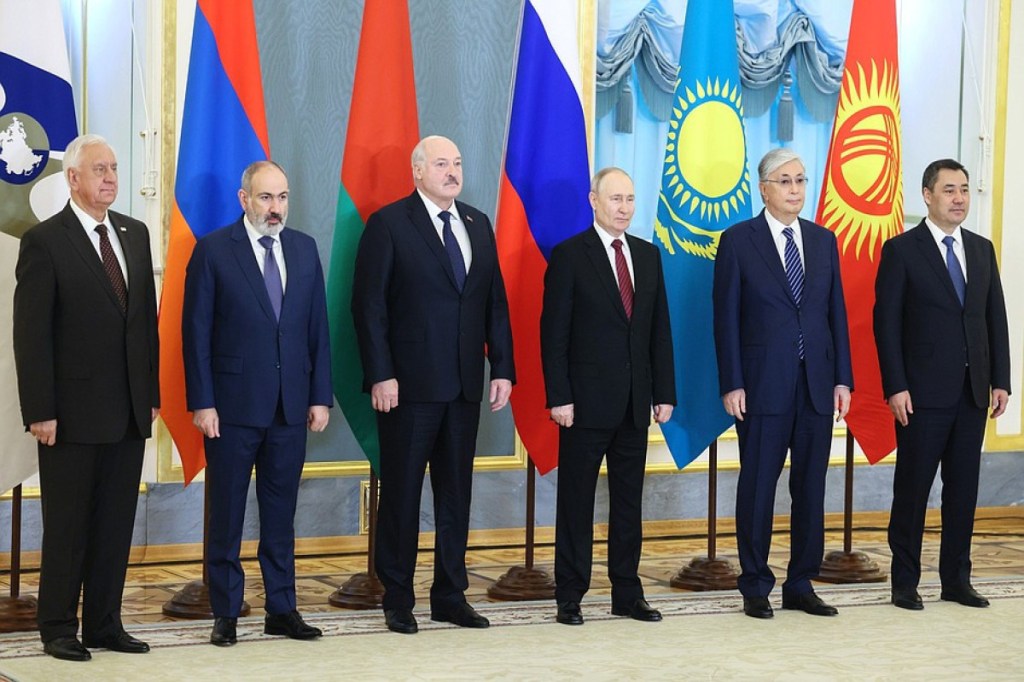
Following the meeting of the former USSR republics leaders during the Victory day in Russia, V. Putin hosted regular meeting with the leaders of member states of EAEU (Euroasian Economic Union) in Moscow on May 25.
All members of the organization are interested in expanding and developing the economic union. On the one hand, the EAEU makes it possible to mitigate the consequences of Western sanctions for the Russian economy. On the other hand, sanctions allow other participants to get economic advantage. Kyrgyzstan, following the results of 2022, was able to increase exports to Russia by a third. This year, at least the same dynamics is expected to be maintained, unless force majeure occurs. The same dynamics could be traced also in the Russia-Armenia economic relations. Trade between Armenia and Russia practically doubled to almost $5 billion in 2022. What is more, Armenia’s economy grew by 12.6% in 2022, the highest growth recorded over the last 15 years. Russia-Kazakhstan mutual trade rose significantly thanks to the reexport of goods from Kazachstan to Russia in the previous year.
The increasing bilateral trade volume between Russia and other member-states of the Eurasian Economic Union (EAEU) demonstrates that the leaders of this integration bloc are inclined to enhance cooperation and establish economic and trade relations with Moscow, despite the ongoing conflict in Ukraine, stringent sanctions against Russia, and even charges against the Russian President by the International Court in The Hague. Their willingness to pursue this collaboration stems from the expectation of achieving substantial economic benefits.
Simultaneously, Moscow has implemented a policy aimed at strengthening its relations with countries situated within its historical geopolitical sphere of influence, particularly in Central Asia and Belarus. The cooperation within EAEU bloc comes as the most logical option. At the same time, the Central Asian countries, which remain largely economically reliant on Russia, exhibit a cautious approach in developing close ties with China, therefore opting for a cooperative approach with both China and Russia.
 Global News Insider