
Photo: Xinhuanet
By: Marián Šeliga
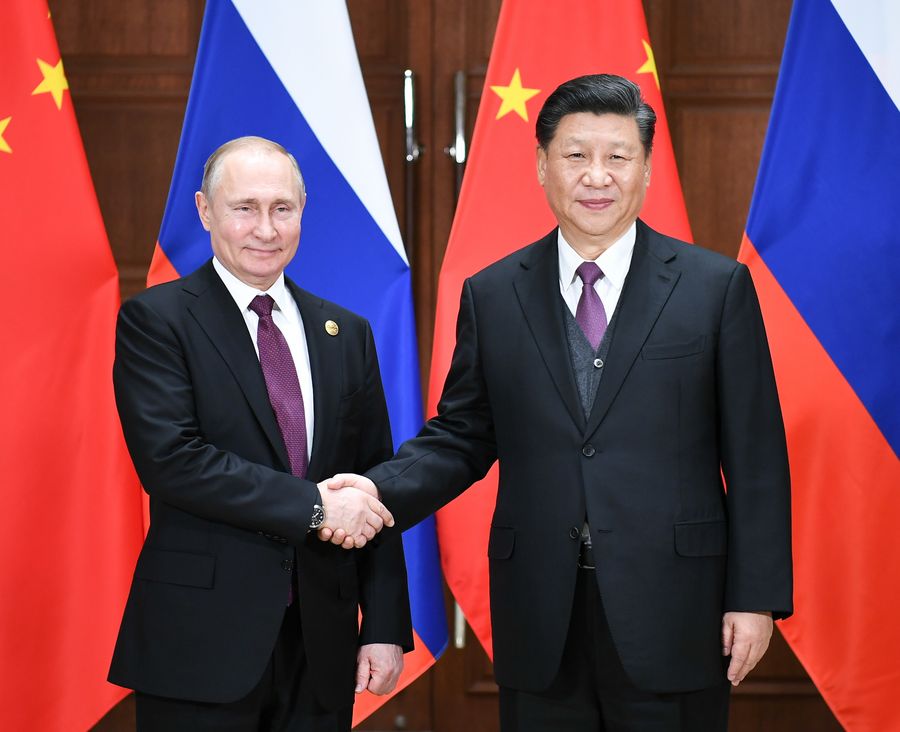
Xi Jinping is set to visit Russia from March 20 to 22
This is will be Xi’s first overseas trip since he was officially rubber stamped as head of state by the country’s political elite earlier this month. The fact that Russia has been chosen as the first foreign destination for Xi to visit shall not be underestimated as Russia might play a significant role in the Chinese long-term geopolitical strategy.
The decision to visit Russia was made by Xi Jinping before International Criminal Court (ICC) issued warrants of arrest for the Russian President Vladimir Putin. Although three world powers – the United States, Russia, and China aren’t part of the ICC system, the issuance of warrants for the arrest of the head of Russia (a party to the conflict) could significantly complicate possible peace talks between Zelensky and Putin, which China is seeking to organize.
Subscribe and receive a weekly in-depth analysis on top international issues.
Sino-Russian cooperation
During Xi’s official visit two leaders are expected to discuss further Sino-Russian cooperation and the pressing geopolitical issues, with special emphasis on the Russia-Ukraine war. The visit comes just around one month after top Chinese diplomat Wang Yi completed his European “peace mission” in Moscow and after China unveiled its 12-point plan to resolve the conflict in Ukraine, which began just over a year ago. The Chinese “peace plan” has been received with great scepticism by Western leaders, but it is possible that it could serve as a basis for further peace talks.
On the other hand, apart from geopolitics, the Kremlin stated that during the visit of Xi some “important bilateral documents will be signed”. It seems that predominantly western experts somehow exaggerate the so-called “peaceful nature” of Xi’s visit, while the main content of the meeting might be the deepening economic cooperation between two countries.
Russian specialists believe that China sees Russia as its closest partner
The Western expert community rarely reads official statements and sources from China and Russia when assessing the real state of Sino-Russian relations. But the fact is that China has been quite consistent in its assessments of the Russian-Ukrainian conflict. Beijing has blamed NATO and the US for the escalation and subsequent Russian invasion of Ukraine. Although some Chinese scholars have expressed differing opinions critical of Russia, Beijing’s official line is consistent and unequivocal. Beijing is calling for a ceasefire, peace talks and an abandoning the Cold War mentality. Although Beijing’s main goals in relations with Moscow may contradict its official public statements, these are only speculations and have not yet been substantiated by facts.
According to the Russian orientalist Andrey Vinogradov “there is a tradition that the head of China, after taking office, makes a visit to the closest partner country. China and Russia now have the closest relationship. Therefore, his arrival in Moscow is natural.”
The arrival of Xi Jinping in Moscow testifies to the special nature of relations between two countries, and also to the fact that China itself is under pressure from the West, and this pressure is constantly increasing – both military and economic. Vinogradov further adds that in 2013, Xi Jinping, when he was elected President of the PRC for the first time, also visited Moscow. There is continuity and tradition in these relations.
When asked why Xi is going to Moscow on his first foreign trip, Andrey Ostrovsky, chief researcher at the Institute of Oriental Studies of the Russian Academy of Sciences, asks a counter-question, “What should China do if America has actually declared war on China? And not only economically, but even militarily. Look at the situation around Taiwan. This is no longer just a matter of economic pressure and economic warfare. On the one hand, the United States recognizes in a number of documents that Taiwan is part of the PRC, and at the same time, weapons are still being supplied there, and separatist tendencies are supported.
China strengthens its diplomatic role
China recently presented its Global Security Initiative (GSI) and within the basic principles of this initiative it successfully brokered a normalisation deal between Saudi Arabia and Iran. Many admit that this was an unprecedented achievement of the Chinese diplomacy. Xi in his third term in power has initiated a very delicate global diplomatic strategy with possible high “upside” for China. By calling for peace and deepening economic cooperation with its partners, whether they are authoritarian, democratic, or even under sanctions, and whether its peace-loving mission can lead to any tangible results or not, China will be further considered first of all in the countries of the “South” as a country that is striving for peace, not war. However, if Beijing succeeds even in resolving the conflict between Russia and Ukraine, this will create for China the image of a country that is capable of resolving any conflicts peacefully. This is a win-win scenario for China.
 Global News Insider