
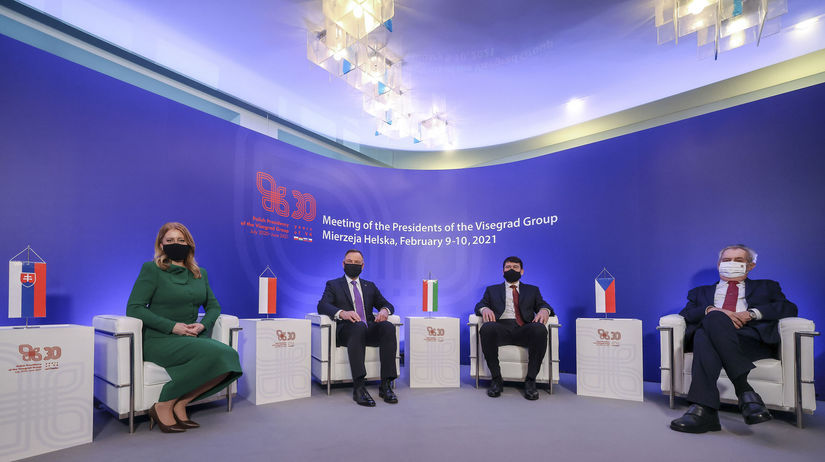
Photo by: pravda.sk
Author: Jozef Hrabina, Chief analyst at the Council of Slovak Exporters
Visegrad4 is facing challenging times. Slovakia, Czech Republic, Poland and Hungary are dealing with socio-political realities, issues with broader internationalisation, geopolitical pressures and economic issues related to the supply chains crisis and energy prices crisis. Although the Members of the V4 do share many common traits, it is no novel that the Central European steering group is internally divided. With that said, overcoming these issues will become an essential task to save the heavily industrialised post-Soviet economies.
Dividing lines in politics
Visegrad members have ongoing disputes with Brussels over the rule of law. Brussels vastly criticises Hungary and Poland for their democratic backsliding in the past few years. While the dispute with Poland is growing in strength and the conflict with Berlin adds up, Hungary’s issues still remain at the ideological level. Despite their post-communist nature, Slovakia and the Czech Republic are generally more aligned to Brussels. Such differences within the V4 result in struggles to find a political consensus on many issues.
Facing new geopolitical realities
Current war in Ukraine is pushing all Central European countries together. In case of Russian victory, the geopolitical fault lines in the entire region would change. With that said, Poland leads the regional rearmament as it plans to spend 5 % of its GDP on defence spending in years to come.
Gradually becoming the EU’s military leader, Poland finalises purchases of 500 HIMARS, 250 M1 Abrams tanks + 112 pieces of the used M1 tanks and 32 F35 jets. Simultaneously, Poland purchased almost 1000 K2 Tanks, 600 pieces of K9 howitzers and 48 FA-50 fighter jets from South Korea.
Moreover, Polish ruling party PiS regularly opens the question of sharing nuclear arsenal with the US, and recent news says that Poland and the UK are exploring opportunities to develop surface-launched long-range missiles.
Other V4 countries purchase land and air military equipment. Slovakia has just recently procured the Infantry fighting vehicles for €1,7 billion (the biggest military tender in its modern history). Simultaneously, the Czech Republic eyes the history’s highest procurement for 24 units of F-35 and 210 pieces of IFV CV90. By contrast, Hungary enhances cooperation with foreign defence companies, such as Rheinmetall,which built a factory for LYNX vehicles in the country. According to portfolio.hu, the procurement of reconnaissance, strike and suicide drones is also expected to be announced.
The military industry has a long tradition in the region and ongoing geopolitical crisis could help revive it. The new wave of excess military spending could also be used to promote cooperation in the defence industries and military innovation, which could put Central Europe on the map of global arms trade again.
Economic crisis
Heavily industrialised V4 economies rely on energy resource imports. Especially gas, oil and uranium are in high demand in the countries. With recent Polish purchases of six small modular reactors and the construction of the first-ever nuclear reactor in the country, it is clear that, just like Poland, the region is likely to rely on a mix of nuclear and renewables for the future.
Apart from a severe energy crisis, all V4 countries are dealing with an average of 16% crippling inflation compared to the 10 % average in the European Union. Having said that, one of the primary drivers behind this are the lack of supply and high demand.
The supply chain crisis is particularly hard on the heavily industrialized economies as an essential part of global supply chains. The Chinese zero-covid policy was shutting down global automotive hubs such as Shanghai and thereby causing more bottlenecks for essential lifeline of the regional economic performance. Moreover, Slovakia, the Czech Republic and Hungary export automotive that is hit by the semiconductor crisis.
Furthermore, the ever-growing China-West tensions and potential risks of war in Taiwan can become a final blow for automotive in Europe since Taiwanese TSCM produces 63% of semiconductors globally, and China is a significant importer of European automotive.
Nevertheless, automotive issues are a mere symptom of myriad issues with global supply chains. Central Europe and the V4 in particular with its industrial tradition, can offer a politically stable roof and good infrastructure for secure production lines.
Can business revive VisegradFour?
Even though uniting the V4 solely through business is unlikely without a vocal political consensus, it would be bold to claim that the V4 businesses are following the fault lines of politics. Despite political rifts, all V4 countries rank in mutual lists of top international trade partners.
Therefore, at the point when the external pressures are pushing the V4 back together, the business might be the right catalyst for a positive change. Even though companies continuously compete in the market, they also share common needs of industries, such as energy and security of supply chains. The proof of the concept is to be tested at the first-ever Visegrad 4 Business conference in Bratislava on October 13th. Since united business demands of all V4 countries apply more pressure on decision-makers, such events might bore fruit.
Subscribe and receive a weekly in-depth analysis on top international issues.
 Global News Insider