
Photo by: http://www.trtworld.com
Author: Marián Šeliga
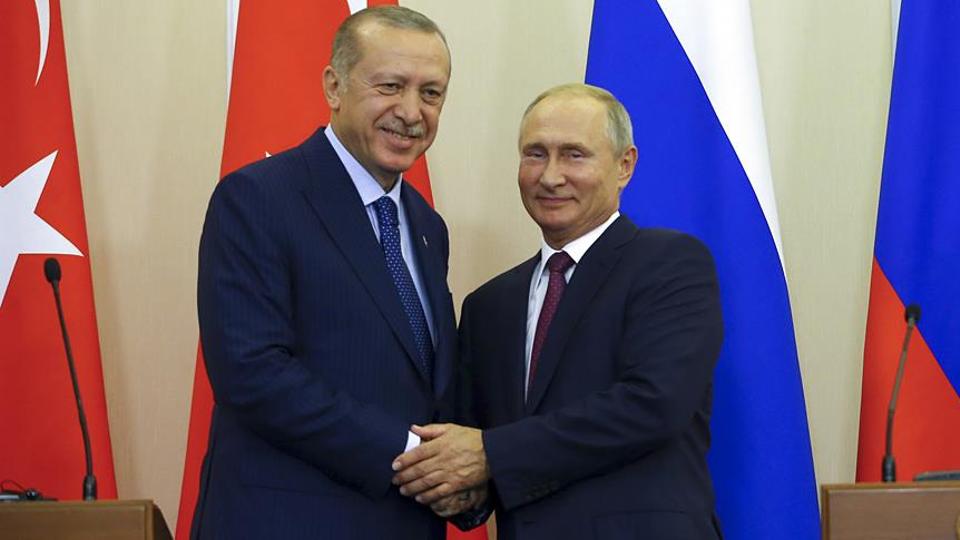
Turkish President Recep Tayyip Erdogan met with his Russian counterpart Vladimir Putin in Sochi on August 5 to discuss a number of issues important both in terms of developing mutual bilateral relations as well as in the international context. As a result of marathon talks, both leaders agreed to strengthen cooperation in trade, finance and energy, sending a clear signal to the world that Russia is not completely isolated and can somehow evade the sanctions regime. Soon after the talks, it became known that 5 Turkish banks would join the Russian payment system “Mir” (an analogue of Western Visa and Mastercard), and part of Turkey’s gas imported from Russia would be settled in rubles. V. Putin thanked R. Erdogan for Turkey’s instrumental role as an intermediary in concluding the grain deal (a deal on the export of Ukrainian grain from the Black Sea), which was accompanied by the West’s promise not to apply any sanctions against Russian agricultural exports. Erdogan was also thanked for the supply of Russian gas to southern and southeastern Europe via the Turkish Stream gas pipeline.
Russia makes concessions to get support of Turkey
Many hours of discussion between Putin and Erdogan gave another very unexpected result, which is regarded by many analysts as a diplomatic victory for R.T. Erdogan. Just three weeks after meeting in Tehran, where the issue of Syria was discussed, but without any tangible result, the two leaders reached a compromise in Sochi on the demilitarization of the Syrian province of Idlib. Idlib is controlled by the Tahrir al-Sham coalition of terrorist groups and is led by al-Nusra Front militants, as well as secular militias under the flags of the Turkish-backed National Liberation Front. The province is also the last stronghold of the Syrian rebel opposition, which has fought fiercely against the Assad regime for years and which Assad planned to crush as soon as possible. The creation of a demilitarization zone in the province will make Assad’s aspiration hardly achievable in the coming months and could be seen as Russia’s concession to Turkey in order to get Istanbul’s support on other vital issues.
Subscribe and receive a weekly in-depth analysis on top international issues.
Turkey is interested in preventing a full-scale Asad operation in the Syrian province of Idlib with the help of Russia, as it fears that it will spread to its allies among the moderate opposition, and this, in turn, will seriously damage the image of Ankara, says Turkologist and political consultant Timur Akhmetov. According to the Russian expert Y. Barmin the result of the Sochi meeting is, though modest, but still a victory for Erdogan, who was able to gain time and postpone the military operation in Idlib.
Escalation in Nagorno-Karabakh
The meeting in Sochi took place against the backdrop of renewed tensions in Nagorno-Karabakh. Just three days before Erdogan’s meeting with Putin, the Azerbaijani army launched grenades and used drones to attack Armenian positions in the territory of the Kalbajar and Lachin regions, killing two Armenian soldiers. This “unexpected” escalation in Nagorno-Karabakh led many analysts to believe that Azerbaijan did it deliberately on the eve of the Sochi meeting to take advantage of Russia’s temporary weakening and create an unfavorable backdrop for negotiations in which Russia was supposed to seek support from Turkey.
Although no agreement was reached on Nagorno-Karabakh at the Sochi meeting, it seems that Turkey, which is banking on its ally Azerbaijan, will continue to more aggressively promote its interests in the region. That may have serious implications for Armenia which is fully dependent on Moscow in the Nagorno-Karabakh issue.
The meeting in Sochi demonstrated that completely isolated by Western countries, Russia is trying to ensure at least a neutral position of Turkey regarding its military operation in Ukraine and therefore is forced to be more careful than usually when approaching Turkey. Erdogan became the first and only leader of the NATO member countries who visited Russia after February 24. At the same time, it is worth noting that the West as a whole strives not to lose the “last channel of communication” with Russia through Turkey.
Turkey is facing unprecedented domestic inflation that prevents foreign companies from investing in its economy, so strengthening economic relations with Russia without outright evading sanctions gives Erdogan additional option to consider when handling domestic economic problems. At the same time, Erdogan, who helped significantly in brokering the grain deal, could be very helpful in future peace talks between Ukraine and Russia. On the other hand, the relations between Russia and Turkey have always been very complex and Moscow is definitely very anxious about Turkey’s supplies of Bayraktars drones to Ukraine.
However, the Sochi meeting also shows that major regional players such as Turkey and Russia will always prioritize their national interests over the obligations they have as members of their respective blocs. This was clearly demonstrated by Turkey even before the meeting in Sochi, when it deliberately blocked the admission of Finland and Sweden to NATO, trying to get some benefit from Western partners.
Please donate to Globinsider team today to ensure we have the strength to provide you with more insider information and in-depth analysis. Just click below and select an amount.
Make a monthly donation
Make a yearly donation
Choose an amount
Or enter a custom amount
Your contribution is appreciated.
Your contribution is appreciated.
Your contribution is appreciated.
DonateDonate monthlyDonate yearly Global News Insider