
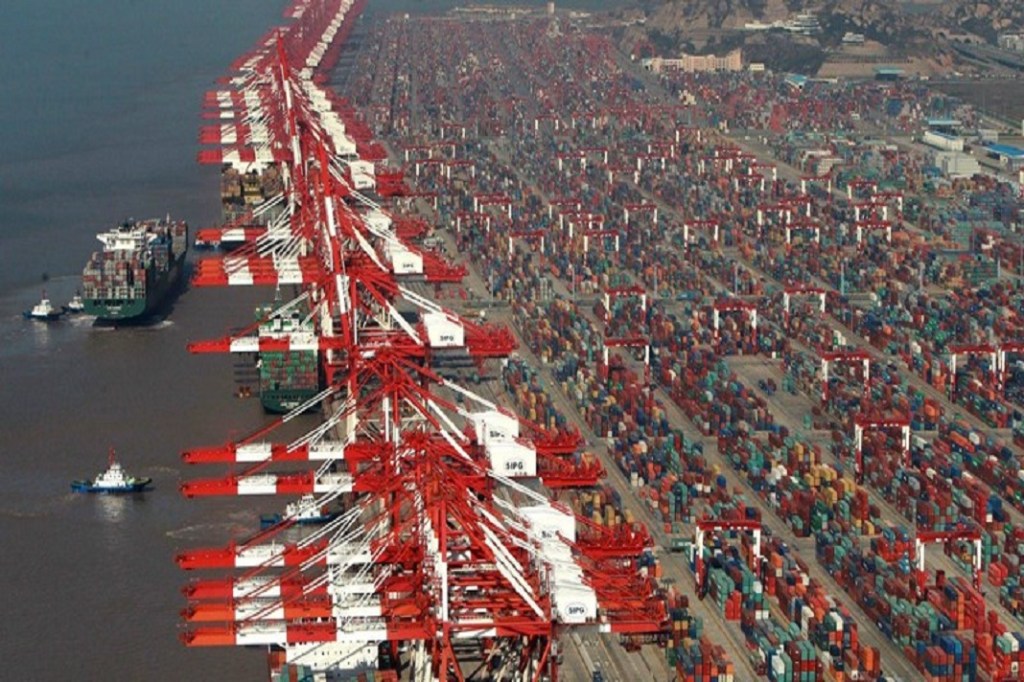
Photo taken by Mfame.guru
Author: Marián Šeliga
Shanghai, the city with the largest container port in the world, was placed under a two-stage lockdown on March 28 in connection with the recent massive outbreak of Omikron in the city. Shanghai’s authorities have not yet announced when restrictions will be lifted. The EU chamber of Commerce in China describes the situation in Shanghai under the conditions of the complete lockdown as a “kind of emergency. It’s a ghost town. You see no people, no cars on the streets and there is a mood of fear here.”
In connection with the lockdown, transhipment volumes at the port of Shanghai are estimated to have decreased by around 40% from week to week. This is a huge drop, especially when 17% of total Chinese exports are exported by sea via the port of Shanghai. Although the port of Shanghai is “technically working”, logistics still faces a shortage of truck drivers who are stuck locked or tested for COVID.
ING Greater China predicts that if the blockade in Shanghai continues throughout April, the city would suffer a 6 percent loss of GDP, which means a 2 percent loss of China’s GDP. Truck drivers entering Shanghai are required to be tested at Covid, which delays the delivery of food and other goods. In the city, many food delivery staff are locked up at home and some people choose not to work for fear of infection. The city residents are not allowed to leave their apartments and houses. There will be a massive testing of the local population in Covid, after which Shanghai will be divided into three risk categories. In areas where there are no positive cases within two weeks the lockdown will be lifted and residents should be given the opportunity to do “appropriate activities” in their neighbourhoods again.
In addition to Shanghai, 22 other Chinese cities have introduced full or partial lockdowns due to Omikron’s latest outbreak. Together, these cities have a population of about 193 million and account for 22 percent of China’s GDP. Media and research company Caixin IHS Markit announced on Wednesday (April 6) that the index (PMI) fell sharply to 42 in March.
Although Shanghai is not an industrial city, it is rather considered the financial and logistics center of Shanghai, and therefore the lockdown in the city does not affect overall production too much. On the other hand, the lockdown in the city may exacerbate the current logistics problems. Many companies have started to divert cargo from the port of Shanghai to the port of Ningbo, leading to an imbalance in logistics (a bottleneck in the port of Ningbo) and a potential increase in the delivery time of goods from China to Europe by several days.
In addition to maritime transport, there are also significant problems with air freight in Shanghai. Restrictions on access to Pudong Airport – China’s main air freight hub, where cargo last year exceeded 4 million tonnes – are already affecting air freight. With the introduction of the lockdown, airlines like Cargolux began reducing flights to Shanghai. The air cargo was diverted to Zhengzhou City. Such redirects are expected to increase transport costs.
Global impact of the lockdown in Shanghai
In our view, the impact of the current blockade in Shanghai on the world economy will depend on how long the blockade lasts. Local citizens expect the block to be lifted within two weeks. However, such a forecast is very optimistic, especially given the 25,000 new COVID cases in Shanghai on Sunday, a very large number for Chinese statistics. The problem of the “zero tolerance policy” is based on the assumption that the Chinese economy may be paralyzed by the uncontrolled spread of covid, which will cause huge social problems. This year, the Chinese leadership is meeting and deciding on a new presidency, so the situation in Shanghai has a huge economic and political impact. In this context, the Chinese leadership is ready to sacrifice GDP just to prevent a nationwide crisis and a complete paralysis of the economy.
Logistical complications – the delivery time of the goods will be extended to a few days, maybe weeks (most of the goods are now forwarded to the port of Ningbo, but it also has its own capacities) and transport prices will thus become more expensive.
Shortage of some goods – many factories are temporarily closing down, not only in Shanghai (as mentioned, there is a partial or complete lockdown in 23 Chinese cities) and this is associated with a temporary shortage of goods (electronics, chips, raw materials).
Impact on the stock market: Logically, this situation has a negative impact on the Chinese stock index, which is going down.
From a geopolitical point of view we estimate that the situation will worsen global supply chains. The energy crisis (high commodity prices) with “botllenecks” in Chinese ports will create a cumulative effect of inflation and shortages of components, chips, raw materials, etc., which will have a negative impact on ordinary citizens and voters in many countries globally.
Make a one-time donation
Make a monthly donation
Make a yearly donation
Choose an amount
Or enter a custom amount
Your contribution is appreciated.
Your contribution is appreciated.
Your contribution is appreciated.
DonateDonate monthlyDonate yearly Global News Insider
One response to “Shanghai faces unprecedented lockdown”
[…] in Eurozone reached 7.5% y/y in April. And the rising inflation will be fueled also by the hard lockdowns and semilockdowns in China, the consenquences of which on the global economy will be seen in the […]