
Written by Igor Zarodov (Russian expert on China and sinologist)
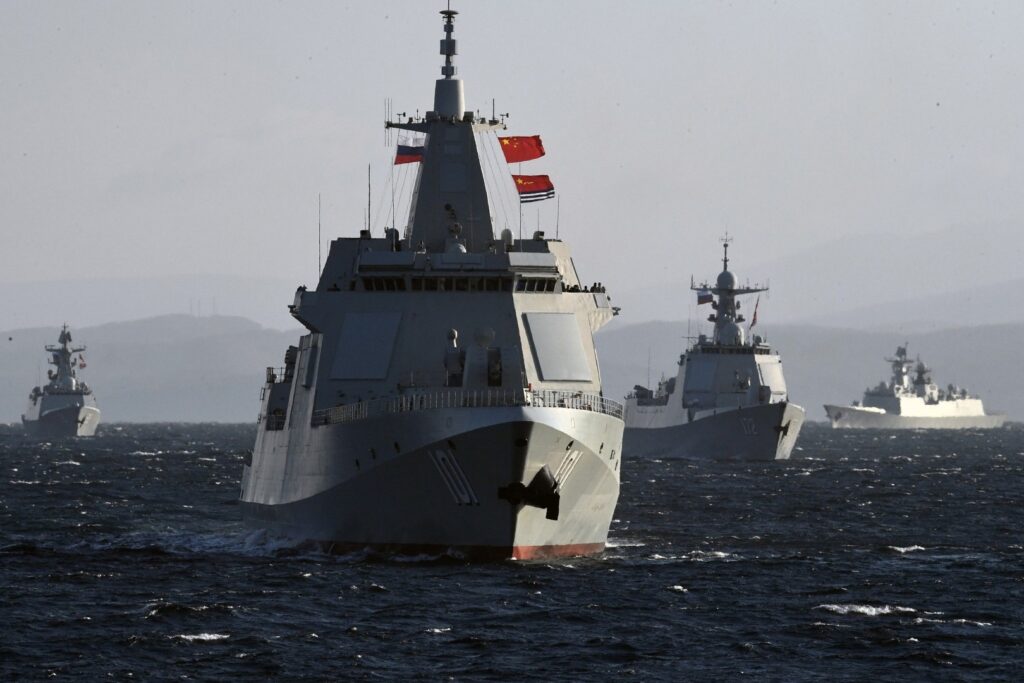
A joint Russian-Chinese naval drill took place in the western part of the Arabian Sea. The naval forces of China at the joint naval exercises called “Peaceful Sea-2022” were represented by the guided-missile destroyer “Urumqi” and the complex supply ship “Taihu”. The exercise has once more highlighted the meaning of China-comprehensive Russia’s strategic partnership of cooperation for a new era.
The Russian-Chinese joint naval drill has begun just a few days after the end of trilateral military naval exercises of Russia, China and Iran. The exercise of the three countries is a new strategy aimed at protecting the economic interests of countries within the trade sea routes of the New Silk Road, as well as ensuring regional security. The first joint naval exercise in such a format took place at the end of 2019.
The recent joint naval drills carried out by the “troublemakers” (the term coined by the USA experts) sends a clear signal to the world democracies that Russia, China and Iran are ready to join armies in order to secure their interests.
It shall be noted that joint naval exercise is a good example of increasing political and military coordination in a multilateral format with the participation of China.
Strengthening the global potential of the naval forces is one of the key tasks of China’s national security strategy. This article tries to explore the latest developments of the Chinese naval forces.
The rapid pace of the creation of the PRC navy
Until the end of the civil war in China, the People’s Liberation Army of China (PLA) did not have its own fleet, as the majority of military operations during the war took place on the Chinese mainland. After the establishment of PRC, the USSR helped China to create the first naval base. By the end of 1970s, China established its own modern military fleet. In the early 2010s, Beijing intensified in expanding its military presence abroad, including the task of ensuring security not only in coastal areas, but also in international waters far from the Chinese borders.
Now China’s navy is the largest in the world, at least in terms of the number of vessels it comprises – 360 units, with plans to increase this number to 400 units by 2025.
Plans to build new modern aircraft carriers, including nuclear vessels
The capability of the Chinese military presence abroad has expanded significantly after the entry into the Navy of the first aircraft carrier in the history of the PRC. The aircraft carrier “Liaoning” was solemnly accepted into the Navy in September 2012. “Liaoning” has a Soviet past: the aircraft carrier was laid down at the shipyard in the Russian city of Nikolaev in 1985 and was originally called “Riga” and then renamed to “Varyag” in 1990. In 1998, the latter was purchased by China and towed to the shipyard in Dalian (arrived in 2002). Initially, China announced that it would build a floating entertainment complex out of an unfinished aircraft carrier, but at the end, the aircraft carrier was completed and modernized to full combat readiness.
In 2013, the construction of China’s first aircraft carrier “Project 001A” began at the Dalian shipyard. The aircraft carrier “Shandong” was launched in April 2017. China will continue to move towards creating its own fleet of aircraft carriers using more advanced developments (“Project 003”).
China steps up its policy to get more commercial (possibly for military use) ports around the world
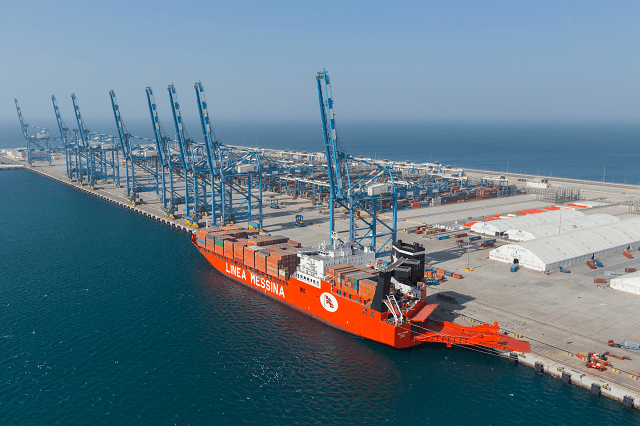
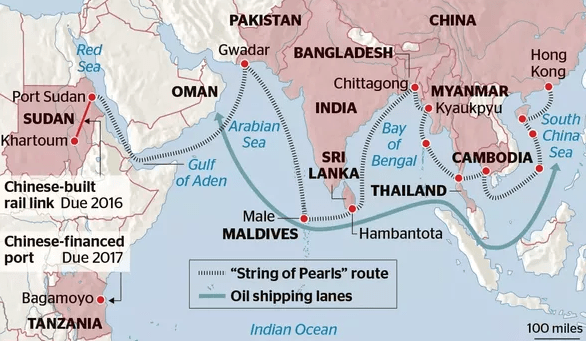
In order to maximize the coverage of possible bases for naval forces, there exists a realistic scenario that the ports currently providing infrastructure for trade and other commercial activities may be used by China also for military purposes, One of such examples is the Gwadar seaport in Pakistan, built by China and put into operation in 2007 as part of the China-Pakistan Economic Corridor. Another examples of the highly possible “military refurbishment” of commercial ports are: the container port of Colombo and the deep water port of Hambantota in Sri Lanka, which was leased for 99 years to China in 2017 ; the port project iHavan in the Maldives, which should become part of the Maritime Silk Road; then the ports of Kyaukpyu in Myanmar and Chittagong in Bangladesh, the construction of which is also financed by the Chinese side. These infrastructure facilities are suitable for the protection of Chinese sea trade routes and control in the Indian Ocean. They are usually ranked as base points in the so-called concept of Chinese strategy “String of pearls”. This strategy is focused mainly on increasing China’s economic, military, diplomatic and political clout in the Indian Ocean Region (IOR).
China has an overseas military base and a desire to build a global network of military bases
In 2017, China opened its first foreign military base designed for 10, 000 people in Djibouti, Africa. In terms of the location of the military base, Djibouti has a strategically important geographical location – it provides China with control over the Gulf of Aden and the entrance to the Red Sea through the Bab el-Mandeb Strait, and therefore over important sea transport routes for oil and other resources. At the same time, the uniqueness of the geolocation is somewhat lowered, if we consider how many military bases of other states are already operating there: the French bases remained there due to the historical colonial past (Djibouti gained independence in 1977), the American base appeared there in 2001. After the start of patrolling the Gulf of Aden and countering maritime piracy, the Japanese came to Djibouti in 2011, then the Italians appeared in 2013. Nevertheless, the establishment of the military base in Djibouti is considered as historically significant event for China.
The base in Djibouti serves as a port for Chinese vessels patrolling the Gulf of Aden, and it may also provide a springboard in case it becomes necessary to evacuate numerous Chinese citizens living and working in the countries of the Arabian Peninsula and the African continent. What is more, the base in Djibouti has been recently expanded and modernized – now it can receive aircraft carriers.
Last year, under pressure from the United States, the construction of a Chinese military base in the UAE in the port of Khalifa was blocked. Earlier in 2019, China secured for itself the use of part of the Ream naval base in Cambodia. China’s persistent attempts to create new military bases for itself will only grow.
Chinese warships in the Gulf of Aden
Since December 2008, as part of the UN anti-piracy operation in the Gulf of Aden, Chinese ships have started patrolling the region: two warships and one supply ship were sent to the Gulf of Aden. In January 2022, the fortieth escort flotilla took over its duty.
One very important fact regarding the Chinese escorts in the Gulf of Aden and the waters of Somalia is often overlooked by the experts – since 2010, the Chinese naval escort group often does not return home after completing its duty, but it continues to pay “friendly visits” to different countries in Africa, Asia, Europe and Oceania. Thus, two groups of Chinese warships patrol the region at almost any time, which provides an important advantage in case of emergency situations, such as unexpected evacuation of Chinese citizens.
“Blue Water Fleet”
The Chinese navy has been progressively upgraded from a “brown water fleet” (a fleet used in river or coastal waters or a naval force capable of military operations in littoral waters) to a modern “blue water fleet” (military vessels that can independently conduct operations in the open ocean). Thanks to participation in missions in the Gulf of Aden, evacuations from Libya in 2011, evacuation from Yemen in 2015, the PLA Navy gained very important experience and it was able to test new types of military equipment. As a result, the PLA navy has become a significant factor in protecting China’s interests abroad. Together with new military bases and the potential to use commercial ports for military needs, this is a demonstration of China’s increased international military-political capabilities.
 Global News Insider
Leave a comment