
(This is the third article in a series devoted to the Donbas conflict and the Minsk agreements. Please read also “Minsk agreements cannot be implemented and the signatories of these agreements know about that. But they continue to play politics. Part 1.” here, as well as “The future of the Minsk agreements. Escalation in the Donbas region. Part 2.” here)
The Russian Ministry of Foreign Affairs has lately published the diplomatic correspondence between the respective Ministries of Russia, Germany and France. This unprecedented move by the Head of the MFA of the Russian Federation, Sergey Lavrov, as he explains, has been made to make public know the situation when “the Russian approaches to the convening of the” Normandy meeting “are being increasingly distorted. “The communication has been published on the official site of MFA Russia and may be found here.
* Let us remind to you that the published diplomatic correspondence between Sergei Lavrov and colleagues from Germany and France is dedicated to the organization of the next meeting of the Normandy Four foreign ministers in order to settle the conflict in Donbas.
The Russian media reported that the Russian MFA took this step “to prevent further speculation” around Russia’s position on the settlement in Donbass. As follows from the published letters, the position of the Foreign Ministry is quite tough. “… You continue to ignore Kiev’s sabotage of the Minsk agreements, forgetting that their implementation is intended to lead to the return of Donbass to Ukraine and thereby restore its territorial integrity,” Lavrov wrote in an address to his Western colleagues.
After the careful reading of the communication between Lavrov and his counterpartners from Berlin and Paris, it seems that there still exists major misunderstanding between the parties concerned, both in terms of the interpretation and implementation of the Minsk agreements. The question remains whether this is made deliberately or the textation of the Minsk agreements leaves some room for further speculations and different interpretations by the parties.
According to the material published, Berlin and Paris are not ready to consider the Donbas issue as an internal issue of Ukraine and they don’t agree with many statements mentioned in the Russian project. The project proposed by the Russian MFA is a very detailed one, containing concrete measures on how to make progress in the regulation of the Donbas issue. It is important to point out that the statements in the Russian project are based mainly on the realization of the Minsk agreements (MA) and the compromises reached on the previous meetings within Normandy format (including Trilateral Contact Group). Moscow tries to push Western countries to admit that the conflict in Ukraine is rather an internal issue of Ukraine and shall be discussed between Kiev on one side and Luhansk and Donetsk on the other. It also tries to explain to its partners that Kiev has recently adopted a rather controversial law which prevents Ukraine from implementing Minsk Agreements and by doing so makes it practically impossible to put an end to the conflict in the Eastern Ukraine.
As it is pointed out in the letters sent to Moscow, Berlin and France certainly are not ready to admit Luhansk and Kiev as the parties of the negotiation process. The republics of Luhansk and Donetsk are not recognized by Western countries and they are largely supported by Moscow, as western specialists point out. It is evident from the communication with Lavrov that Berlin and Paris try to push Russia to confirm its active role in the conflict. They propose also to give more room for the OBSE mission in the war-torn region.
It is becoming more and more obvious that the Donbas issue will not be settled in the foreseeable future. Absolutely different interpretations of the Minsk agreements and the way how the conflict shall be settled gives Moscow and Western members of the Normandy format a very little space to manoeuvre and progress.
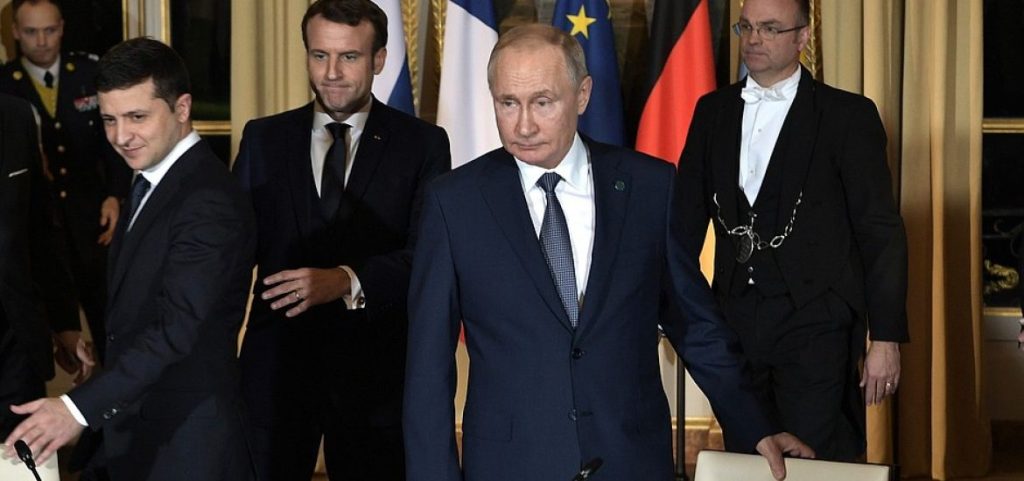
The irony is that this unprecedented move by the Russian MFA (the publication of diplomatic communication) only sheds light on the fact that this issue is today farther from settlement than it was in 2015. There has been practically no progress on the issue since the latest meeting of Normandy four in Paris (December 2019). where the Ukrainian President Zelensky tried to persuade V. Putin that the external conditions since signing Minsk Agreements have changed and it is time to make some compromise on the Agreements. But Russia is evidently not ready to renegotiate the already signed document and the status quo in Donbass will not change for the foreseeble future. Today it is clear to all stakeholders that the texting of Minsk agreements is unfavourable to Ukraine and the signing of MA by Mr. Poroshenko was practically a diplomatic victory of the Kremlin. Poroshenko signed the agreements in hope that the antirussian sanctions to come will in the following years force Moscow to make concessions on Donbas. But that did not happen. The implementation of MA in their signed version implies the changes in the Constitution of Ukraine and practically the federalization of the country. This is something Zelensky and Ukraine largely supported by the EU and USA will never accept.
 Global News Insider
Leave a comment