
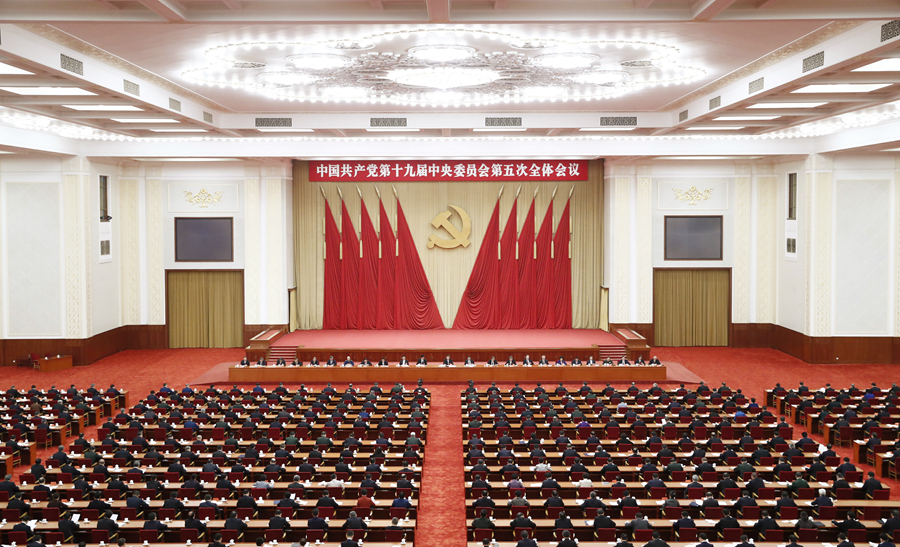
The fifth plenary session of the 19th Central Committee of the Communist Party of China (CPC) was held on Oct 26-29th. The main results of this plenary session were reflected in the communique which will be adopted at the meeting of the Chinese Parliament in 2021. Foreign analysts try to learn more about the main message of this communique as well as the way China would develop as a system in the years coming.
Apart from setting the goals for the future development, the fifth plenary session of the 19th Central Committee of the CPC has summoned up the results of the 13th Five-Year. During this Five-Year plan (13th FYP) China has made progress in many fields including the eradication of poverty (more than 55 million people have been lifted from the poverty) and building effective medical insurance system. According to the released communique the country’s basic medical insurance has covered over 1.3 billion people and basic old-age insurance has covered nearly 1 billion people.
Meanwhile, during the past five years, more than 60 million new jobs were created in China’s urban areas, it said.
As for the fight against the COVID-19 pandemic, the whole country coordinated the prevention and control work with economic and social development and put people’s safety and health first.
The session adopted the CPC Central Committee’s proposals for the formulation of the 14th Five-Year Plan (2021-2025) for National Economic and Social Development. The session also set up Long-Range Objectives through the Year 2035.
The main goals for the upcoming development were revealed in 12 concrete measures to achieve them. Although there is no evidence to assume that some of these measures are more important than the others, we would like to highlight the most important of them, again without no ambition to underestimate the importance of the other measures.
– Nurture a strong domestic market and establish a new development pattern. The country will smooth domestic circulation and let domestic and international circulation reinforce each other, spurring consumption in an all-round way and expanding investment.
According to the Chinese Communist Party, China will further support the OBOR initiative and cooperation with other countries whereas it stresses the necessity to grow the internal demand of China within so called “domestic circulation.” This term has been coined lately in China and there are no massive analytical materials about it yet, which would capture the full meaning of such definition. Nevertheless, such definition reveals the ambition of China to change its model of economic development in the more complex and ever-changing international environment. At the same time it shows a high degree of flexibility of the Chinese planners amid the uncertainty brought about by coronavirus pandemy and the ever-escalating Sino-US trade war. This is a signal mainly for the domestic audience, that in the crisis moments the Chinese leadership is rather effective to implement measures trzing to cope with
At the same time, we see that China has organized this plenary session in a normal (in person) regime (198 members in place) whereas many international organizations and national parliaments meet in online contactless regime. This also demonstrates that China really has grasped the full control of the virus pandemy within its country. This happens against the background of massive lockdowns across the globe and growing propability of the next (3rd) wawe of coronavirus which may come in the spring of 2021.
The message sent by the leadership has two audiences: internal and external, whereas the first one seems to take priority now.
 Global News Insider
Leave a comment